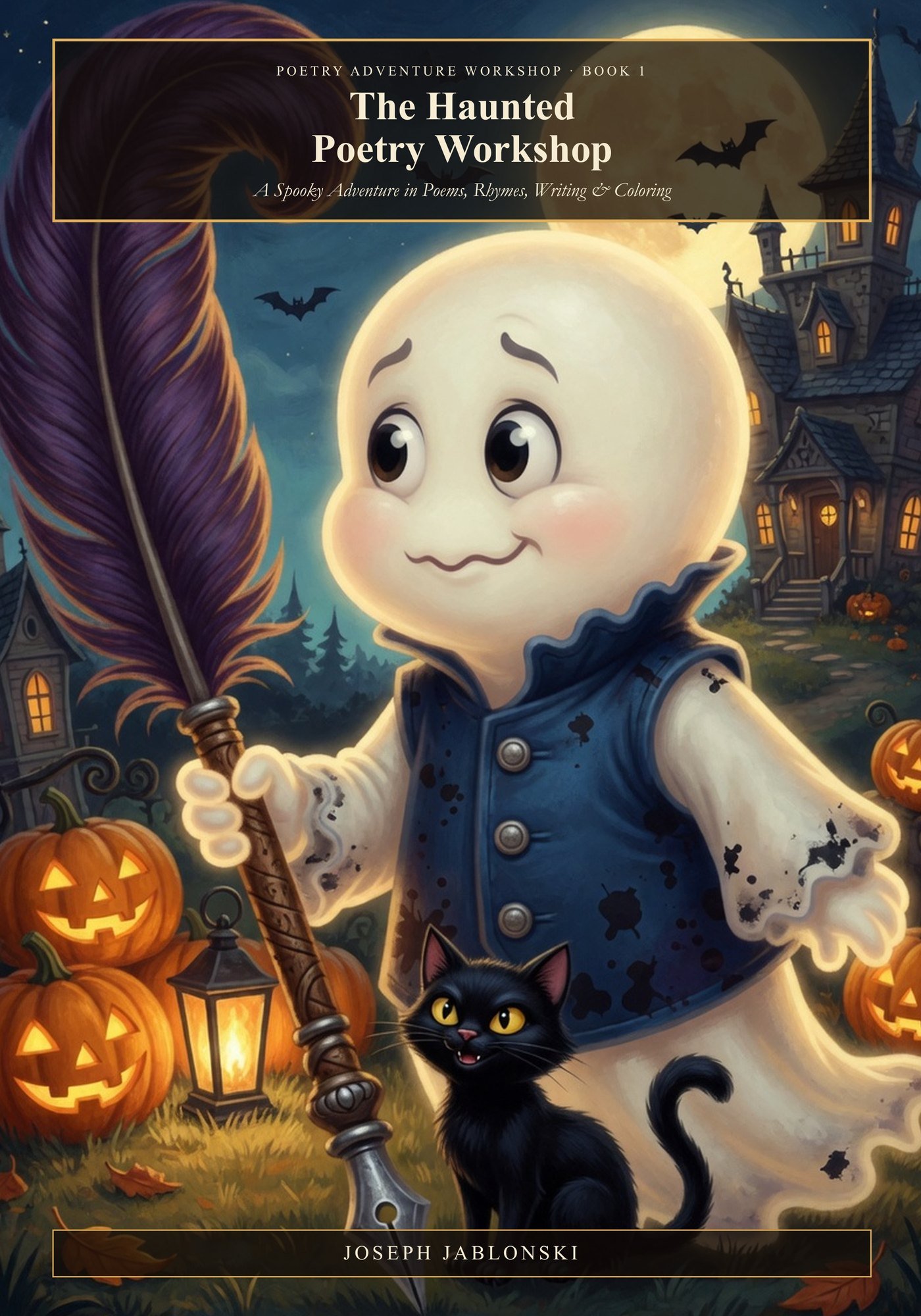
Poetry Adventure Workshop — Book 1
The Haunted
Poetry Workshop
Parent & Teacher Companion Guide
Ideas for Reading, Writing, Teaching & Creating with Poetry Adventure Workshop Book 1
Joseph Jablonski
Published by JabMed Media
Ages 8–12 • Grades 3–6
ISBN-13: 979-8-9984535-0-2
A free companion for families, classrooms, homeschool, and libraries. It helps adults use the book. It does not replace it.
Welcome
The Haunted Poetry Workshop is designed so children can enjoy it independently, but it can also become a flexible poetry unit for families, classrooms, and homeschool settings. This guide offers ways to pace the adventure, discuss the poems, extend the writing, and adapt activities for different learners.
What the book combines
- A connected story, told across one night in the mansion
- A model poem at every stop
- Plain-language instruction in the form
- A guided writing challenge
- A puzzle, game, or clue that belongs to the story
- A coloring page or other creative activity
What adults need to know
- No special poetry background is required. Each stop explains the form in language a writer ages 8–12 can use, and an adult can read alongside.
- Use one haunted stop at a time. You do not need to preview the whole mansion before you begin.
- The book may be used flexibly. A family can linger on one poem. A class can use a stop as a single lesson. A library program can take the first gate and stop there.
- There is no single required pace. The plans later in this guide are options. Midnight is the deadline inside the story, not in the kitchen or the classroom.
This guide does not replace the book, and it does not give away the puzzles. Writers meet the answers by doing the work. Please do not photocopy the book. Permission to print this guide is on the last page.
A Simple Way to Use Each Haunted Stop
The book walks every stop in the same order: read the model, discover the form, write, play, then color. This guide keeps that order, folds coloring into Play, and adds a short Reflect so the stop ends with a question.
READ
Read the model poem and the story setup. Read the poem aloud if you can. Poems like being heard.
DISCOVER
Notice how the poetry form or technique works. The Discover page tells the truth about the rule, including when a form has more than one honest version.
CREATE
Complete the guided writing challenge. The word banks and lines are there to start a real poem, not to fill a blank with one word.
PLAY
Use the puzzle, game, clue, or coloring activity. In the story, that page does a job: it unlocks, restores, repairs, or opens something.
REFLECT
Ask what worked, what surprised the writer, or what they would change. Four ready questions are on the lesson-plan page.
Materials
- The Haunted Poetry Workshop
- A pencil and an eraser
- Colored pencils, crayons, or markers, as appropriate
- An optional notebook or loose paper, if a writer wants more room than the page gives
A stop can take one sitting or two. If the writing is going well, stay there. If a puzzle is frustrating, color the scene and come back. Messy drafts are part of the workshop.
A 30–45 Minute Poetry Adventure
Use this when you have one sitting and one stop. Pick the stop the group needs. You do not have to start at the gate.
5 min
Enter the Stop
Read the story setup and the model poem. A second reading can be slower, so listeners can hear the pattern.
5–10 min
Discover
Discuss the form. Ask writers to point to one example in the model: a rhyme, a syllable count, a line break, a picture, or the shape on the page.
15–20 min
Create
Complete the writing challenge. Quiet drafting first. An adult may scribe for a writer who is speaking the poem faster than the pencil can move.
5–10 min
Play
Puzzle, coloring, sharing, or reflection. If the clock is short, choose one. Sharing one line is enough.
Discussion prompts
- What do you notice first about this poem?
- Which words create the strongest picture or sound?
- What rule or pattern helped shape the poem?
- What would you change if you wrote another version?
If several writers finish early, invite a second version with a different mood, or send them to the extension ideas. Do not grade the poem in this sitting. Name one specific thing that worked.
One-Week Mini Unit
Five days. A sample path through the mansion, not a requirement to finish all thirteen stops. Choose the stops that fit the writers in front of you.
Day 1
Enter the Mansion
Read the invitation, meet Quill and the cat, and look through the Poetry Detective Toolkit. Then take Stop 1, the acrostic at the Crooked Front Gate.
Day 2
Sound & Structure
Choose two form-focused stops. A strong pair is haiku and cinquain, or limerick and couplet. Teach one pattern, then the other. Do not stack all four unless the group asks for more.
Day 3
Images & Senses
Choose sensory, shape, or personification-friendly work from the book. The Witch’s Kitchen, the diamante laboratory, and the Spider’s Staircase fit this day. One stop is a full day. Two is plenty.
Day 4
Story & Voice
Use narrative, free verse, or ode-style work. The Portrait Gallery, the ballroom ode, the room beneath the stairs, and the Forbidden Attic all belong here. Pick the one that matches the group.
Day 5
Midnight Poetry Celebration
Finish a selected challenge. Revise one poem, even if the revision is a single line. Read aloud. The book’s Certified Haunted Poet certificate can close the week when a writer wants it. Skipping the certificate is fine. The Midnight Tower ballad is a handsome finale if you have time for it. It is not required to “complete” the week.
You do not need to finish all 13 stops in one week. A week that produces four honest poems has done the work.
Turn the Whole Book into a Poetry Unit
Thirteen stops can stretch across a month or a season. Pick a pace, then change it when a writer falls in love with a form or needs a shorter day.
Fast Adventure
2–3 stops a week
About 5–6 weeks.
Useful for an October unit, a short homeschool block, or a class that already knows several forms and wants the story.
Steady Adventure
1–2 stops a week
About 7–10 weeks.
Room to draft, revisit a Discover page, and still finish the tower before the season changes.
Relaxed / Homeschool
1 stop a week
About 13 weeks.
One stop is the whole poetry lesson. Handwriting, read-aloud, and coloring can share that day.
Make the pace fit
- Adults can skip, shorten, or revisit a puzzle, a coloring page, or a writing frame.
- A writer who loves one form may stay an extra day and try a second poem in it.
- A stop that does not fit the week can wait. The mansion keeps.
- If one sitting is too much, read and discover first, then write and play the next time.
- The map of the mansion, near the front of the book, shows the path from the gate to the tower. You may walk it out of order.
These ranges count stops, not school days lost to assemblies, fevers, or a poem that needs another draft. Build the slack in. A finished unit is the one the writers actually lived, not the one that touched every page.
Supporting Different Writers
These are practical choices for a writing day. They are not labels, and they are not a diagnosis. The same writer may need the first list on Monday and the third list on Thursday.
Reluctant writers
- Brainstorm aloud before anyone picks up the pencil.
- Allow a drawing before the lines.
- Let an adult or a partner scribe while the writer dictates.
- Use the word banks already printed in the book.
- Fewer strong lines are better than a length the writer did not choose.
Developing writers
- Focus on one technique at a time. A stop is already built that way.
- Read the draft aloud. The ear catches a crowded line the eye forgives.
- Underline strong verbs and images. Leave the rest alone for now.
- Revise one line rather than rewriting the whole poem.
Confident writers
- Add an extra stanza when the form allows it.
- Change the point of view. The cat, Quill, and the house see different nights.
- Experiment with form. Try the same idea once inside the stop’s pattern and once beside it.
- Revise for a sharper image or a cleaner sound.
- Create a second version with a different mood.
Across all three: spelling can be cleaned up after the idea is safe on the page. The workshop cares about the poem first.
Discussion & Extension Ideas
Optional. Use one. None of these is required, and none of them replaces the stop in the book. They give a finished draft somewhere further to go.
- Read a poem aloud two ways, once quiet and once with a bounce, and talk about how the rhythm changes the feeling.
- Find one tired verb, such as went, was, or got, and trade it for a verb that shows an action.
- Turn one room or object from the stop into a metaphor. The gate might be a question. The attic might be a held breath.
- Illustrate a favorite line in the margin or on a separate sheet.
- Perform the poem with one gesture for the turn, or for the last line.
- Keep a family or class poetry wall. Each writer adds one line, with a name if they want it there.
- In pairs, offer one specific observation and one question. Save grades and scores for another day.
- Write a short extra poem from Quill’s point of view. He hiccups when he tries to be frightening, and his pen is longer than he is.
- Imagine what the black cat noticed when nobody was looking. Three lines, only what the cat would know.
- Invent a fourteenth room. Name it, choose the poetry form that belongs there, and say why that form fits that room.
Extension 10 is an invention for this guide. It is not a hidden page in the book. If writers build that room, they may keep it in a notebook. The published mansion still has thirteen stops.
Home, Classroom & Homeschool
The same stop works in all three places. The difference is the time, the noise, and whether anyone is collecting the poems.
At home
- Hold a family poetry night: one stop, then read the new poems to each other.
- Use a single stop as a weekend activity.
- Keep the book for seasonal creative time. Halloween is a natural door. The writing still works later in the year.
- Read and share without pressure to grade every poem.
In the classroom
- A writing center with the book, pencils, and the five-part quick start.
- October language arts, or a poetry-form introduction in any month.
- An early-finisher or enrichment choice for a writer who wants another stanza.
- A small-group station: one adult, a few writers, one stop.
Homeschool
- A flexible language-arts unit beside the rest of the week.
- Combine a stop with read-aloud practice. The model poem is the first text.
- Use the writing lines for handwriting, the word banks for vocabulary, and the scenes for illustration.
- One stop a week matches the relaxed plan on the pacing page.
The book is designed as a creative poetry activity resource and does not claim to replace a complete language-arts curriculum.
Librarians can use one stop for a program: read the setup, try the form together, and send writers home with the book if the collection has a copy. This guide may be printed for that program. The book may not.
Poetry Adventure Workshop
Keep the Adventure Going
Each book places poetry inside a different story world. Readers read a model, discover how the form works, create a poem of their own, play, and color. The world changes. The habit of looking closely at a poem stays.
Book 1 — The Haunted Poetry Workshop. Available now. A spooky adventure in poems, rhymes, writing, and coloring. Ages 8–12. Grades 3–6. Paperback, 106 pages. ISBN-13: 979-8-9984535-0-2.
Next — The Winter Poetry Workshop, Book 2. The next book in the series. A publication date has not been set.
Joseph Jablonski
JabMed Media, a fictitious name (DBA) of JabMed Holdings LLC
Print and use
Permission is granted to print and reproduce this companion guide for personal, family, homeschool, library-program, or individual classroom use. It may not be resold, republished, uploaded for redistribution, or included in commercial products without written permission from JabMed Media.
This permission covers this companion guide only. It does not allow photocopying The Haunted Poetry Workshop.
© 2026 Joseph Jablonski. Published by JabMed Media, a fictitious name (DBA) of JabMed Holdings LLC.